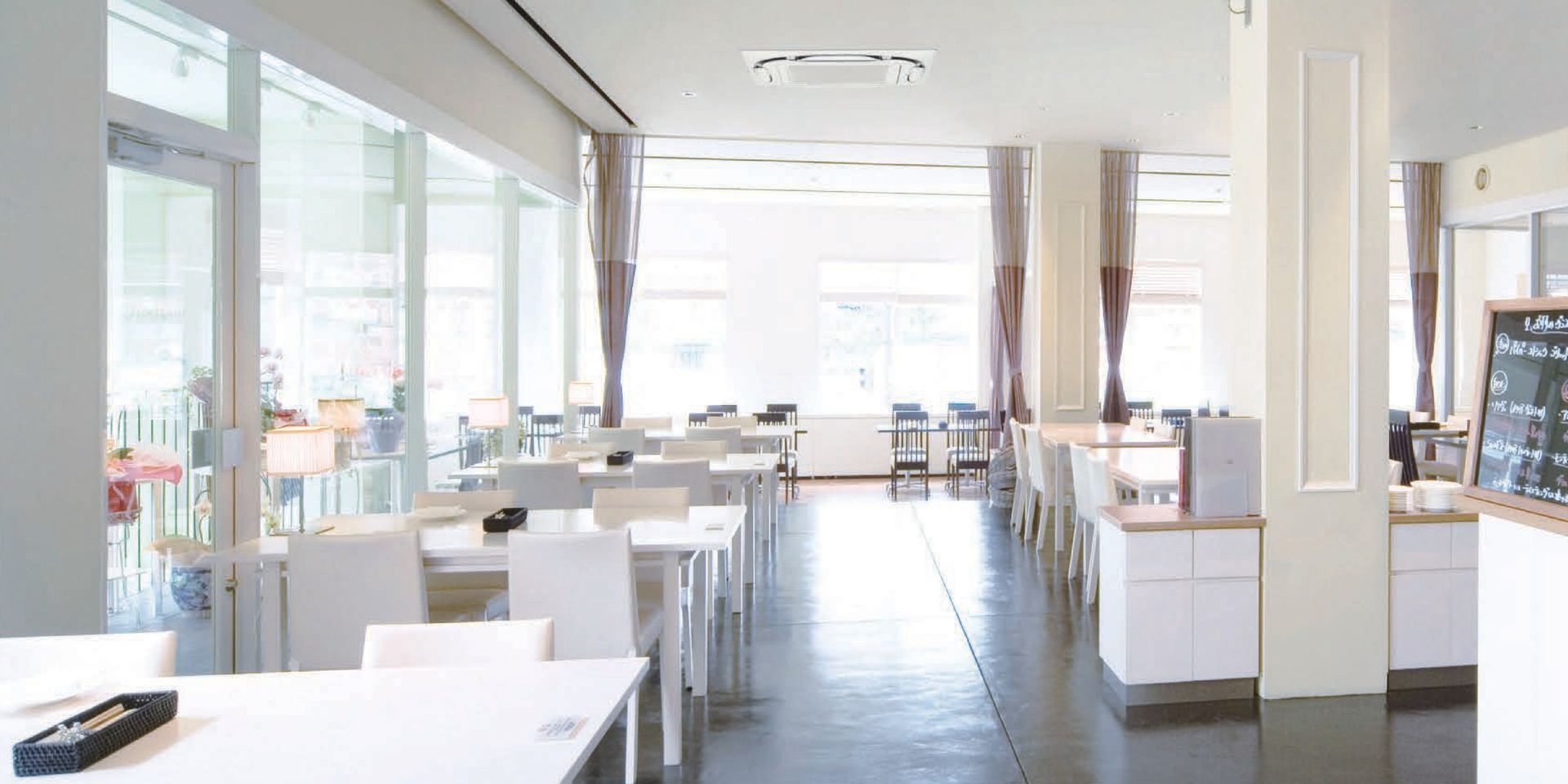
AC Cassette: A Relevant Cooling Solution for Modern Business Spaces
AC cassette often signals that a business space has upgraded its standards. Cooling is no longer just displayed; it works seamlessly to maintain comfort, often unnoticed by occupants.
Operating hours for SMEs average around 12.46 hours per day, meaning AC load patterns are significantly heavier than in residential settings. No wonder this system dominates commercial spaces in Southeast Asia, capable of cooling large areas evenly without compromising aesthetics—a feat difficult to achieve with wall-mounted AC units.
But what type of AC cassette aligns with your business model and operational rhythm? Find out in this article.
What Makes AC Cassette Functionally Different?
Unlike split ACs that push air from one side of a wall, cassette ACs or ceiling-mounted cooling systems are installed centrally in the ceiling. They also distribute air in four directions simultaneously. This makes the cooling feel more natural and evenly distributed throughout the room, rather than just being cold near the unit.
In HVAC testing, mature 4-way cassette systems show temperature uniformity improvements approaching 77.5% compared to single-direction airflow. This means cold air no longer pools in one spot but truly spreads across the entire space.
That’s why cassette-type air conditioners feel closer to central system cooling logic, yet remain flexible, independent solutions that offer far greater precision for commercial spaces.
Why AC Cassette Fits Business Spaces
Commercial spaces operate under much harsher conditions than homes. Doors open frequently, foot traffic is high, and heat from lighting and equipment runs continuously.
Each person indoors can add roughly 600 BTU/h of heat load, equivalent to about 175 watts, before other factors come into play. Therefore, AC cassette capacity for offices becomes highly relevant, as the system can handle dynamic loads without losing stability.
While residential ACs rely on on-off cycles suitable for living patterns, commercial ceiling-based units maintain consistent temperatures throughout operating hours. Some large residences do use them, but their DNA clearly stems from business needs.
Determining the Right Capacity Without Expensive Mistakes
Many business owners get stuck choosing commercial AC cassette inverter units based solely on room size, which is only half the story. High ceilings, glass walls, and human activity drastically change cooling requirements.
This is why undersized units run constantly, wasting energy and wearing out quickly. Conversely, oversized units make rooms feel cold but humid—a phenomenon often overlooked.
For ceiling-mounted AC cassette systems, a more accurate approach is calculating the actual heat load: ceiling height, number of people, light intensity, and running machinery.
Roughly, residential spaces typically require 20–30 BTU/h per sqft, while commercial spaces can jump to 30–60 BTU/h or more. These figures distinguish a properly matched choice from one that merely looks big.
Are AC Cassettes for Business Spaces More Power-Hungry?
This question frequently arises and often haunts business owners deciding on the most suitable cooling system. Cassette cooling systems generally fall into inverter and non-inverter types.
To save energy, selecting inverter technology suited to commercial loads is a smart move. This allows the system to run steadily without aggressive cycling like non-inverter residential ACs.
In appropriately sized spaces, this actually keeps energy consumption controlled throughout long operating hours. However, when a large-capacity system is forced to cool a small room, efficiency collapses.
High power is used for mismatched loads, resulting in waste and uneven comfort. The key lies in matching the system to the room's characteristics, not just the unit's size. When the AC aligns with the actual heat load, commercial ceiling-mounted coolers not only provide more stable cooling but are also more cost-effective than residential split units.
Time to Switch to a More Relevant Light Commercial Solution
Ceiling-based cooling systems become the most logical choice when your space exceeds 40 square meters, uses drop ceilings, operates over eight hours daily, and demands a clean look without wall-mounted units.
From here, you can already see the difference between AC cassette and split: one is designed for business, the other for residential living. The SkyAir category falls into the light commercial range, available in both R32-based inverter and non-inverter versions.
This allows you to tailor the solution to your business needs and space characteristics. Under long, fluctuating operational loads, inverter variants offer efficiency that can save approximately 30–50% in energy, while non-inverter versions remain a stable and reliable solution for more constant loads.
The choice isn’t about which is “more expensive” or “cheaper,” but which makes the most sense for how your space is actually used.
Choose the Right System
You’ve read the signs—now it’s time to design the right cooling system, not just pick a unit. Contact us and explore the most suitable SkyAir Daikin products for your space. Find an AC cassette that is not only energy-efficient but also technology-driven.


