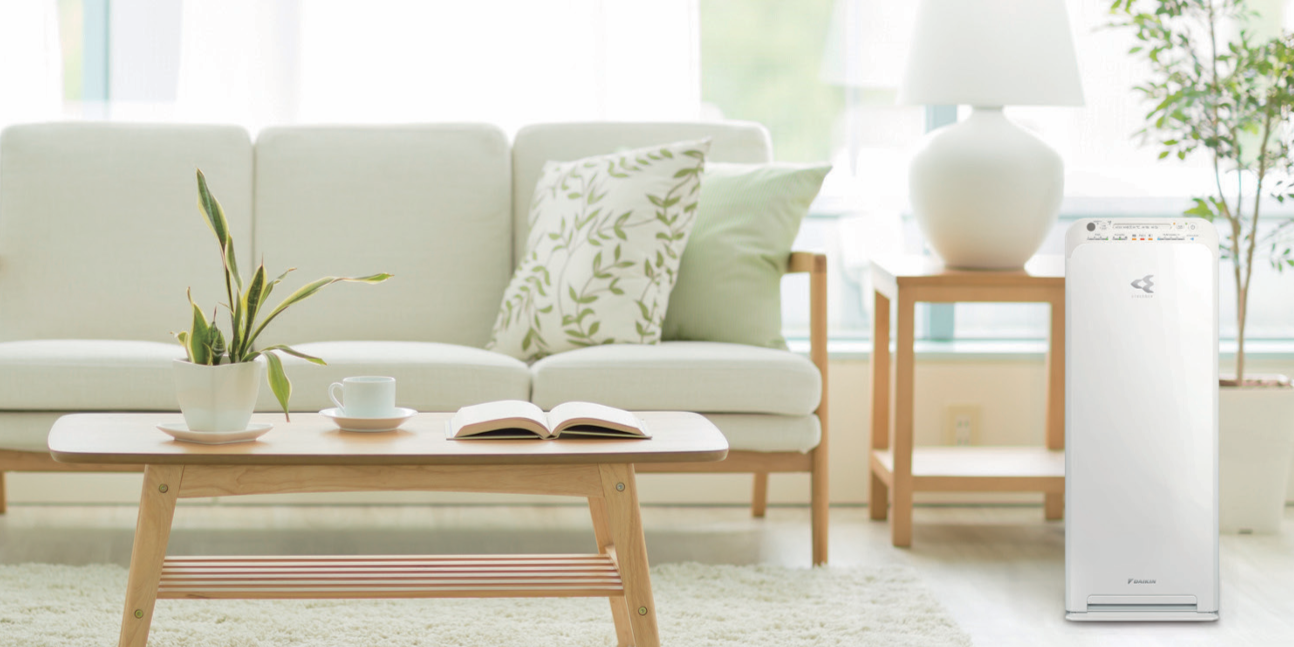
Should an air purifier be left running continuously? This question often makes people hesitant to run their air purifier 24/7. However, it’s important to remember that air is not static; it doesn’t just stay clean once purified.
In reality, indoor air is constantly recontaminated, with indoor pollutant levels often being 2 to 5 times higher than outdoor levels. We also spend approximately 90% of our time indoors. So, who is at fault—the device, or our understanding of how air behaves?
Air Is Always Moving and Recontaminating
Many worry that running an air purifier 24/7 wastes electricity, yet few realize how quickly air becomes dirty again. Every time you walk around, sit on the sofa, lie on the bed, or touch carpets, fine particles are stirred back into the air.
Studies show that human activity can contribute about 50–70% of indoor PM2.5. Even routine tasks like cooking, sweeping, or simply walking around can increase particle concentration by hundreds of percent.
Opening a door, even briefly, allows outdoor PM2.5 to enter. Even if the AC is always running, it does not function as a particle filter. Therefore, indoor air is continuously recontaminated without us realizing it.
How an Air Purifier Works
A purifier does not clean a room once and then stop working. Its operation follows a continuous cycle: drawing in air, forcing it through multiple filter layers, and blowing it back into the room. This cycle repeats endlessly because particulate sources in the home never cease.
The key lies in the CADR (Clean Air Delivery Rate). The closer the CADR rating matches the room size, the faster the unit delivers clean air and maintains low particle concentrations. With the right capacity, room air can be circulated dozens of times per day.
Thus, the purifier’s effect is not a one-time fix but the cumulative result of consistent circulation.
So, Should It Run Continuously or Not?
If you’re hoping for a one-size-fits-all answer, unfortunately, there isn’t one. However, you can adjust usage based on how pollutants enter your home, as well as your comfort level regarding the air purifier’s power consumption and noise levels.
Homes near busy roads generally benefit from 24/7 purifier operation, as external particle exposure tends to be constant. If there are allergy sufferers, infants, or elderly family members, running it continuously on a low setting also provides more stable air quality.
You can utilize the air purifier’s sleep mode for this scenario. This ensures airflow continues while reducing noise output.
Conversely, homes that are frequently unoccupied and rarely have doors opened can run the unit less often or a few hours before the space is used. In contrast, households that frequently open doors in the morning and evening should keep the purifier running longer.
For context, healthy residential ventilation rates are often recommended between 0.35–0.5 ACH (Air Changes per Hour), meaning roughly one-third to half of the room’s air volume is exchanged per hour. An air purifier helps achieve this circulation effect through repeated filtration.
The presence of an auto mode is crucial because sensors read real-time particles and automatically adjust the fan speed. When the air is clean, the unit conserves energy. Conversely, it works actively when particle levels rise. Thus, the device operates based on actual air quality rather than a rigid timer.
What About Power Consumption and Filter Lifespan?
It’s understandable to worry about increased electricity bills. However, in many cases, its power consumption is actually comparable to a small light bulb. Most air purifiers operate within a 30–100 watt range, and on low settings, they consume significantly less.
Wastefulness usually stems from usage habits, such as repeatedly turning the unit on briefly at turbo speed, then turning it off, and repeating the cycle.
This also relates to how long the air purifier runs to clean the room. As long as the CADR matches the room size and you avoid frequent extreme on-off cycling, results will be more stable and consistent.
The internal filters also have a lifespan, and a major factor causing rapid performance decline is a neglected pre-filter. If this component gets clogged, airflow decreases and cleaning efficiency can drop significantly.
Studies indicate this drop can reach up to 50%. Therefore, maintenance plays a critical role, even if it only involves regularly cleaning the pre-filter.
The Most Common Mistake: Turning It Off During “Seemingly Safe” Moments
Turning off the purifier when the room feels comfortable is one of the most common mistakes. Clean air does not guarantee that particles will stop appearing.
As soon as you lounge on the sofa, change the sheets, walk back and forth, or open the door briefly, fine particles are stirred up and reintroduced. Without the purifier continuing to work, particle concentrations gradually return to baseline levels.
Poor timing also makes the unit seem ineffective, as the purifier only runs when conditions have already deteriorated. Running Turbo mode briefly and then shutting it off only wastes electricity and makes the machine’s workload inconsistent.
So, when should you turn off the air purifier? Not when the air feels pleasant, but when pollution sources are genuinely minimal: the house is empty, doors are rarely opened, and no dust-disturbing activities are taking place.
Understand the Pattern, Then Choose the Right One
You no longer view the purifier as a device to be turned on only when necessary. You now understand why air is continuously recontaminated and why operating duration heavily depends on household activity patterns. So, when the question arises whether an air purifier must be left running continuously, you already have the logical foundation.
Still unsure which purifier suits your needs? DAIKIN Air Purifiers offer a wide range of options tailored to different requirements, from electrostatic HEPA filters and STREAMER Technology to Pet Mode for homes with animals. Contact us today to find the air purifier that best fits your home!


