Over 99.9% inactivation effectiveness against the Omicron variant after 2 hours compared to without Streamer
Daikin Industries, Ltd., in collaboration with Professor Tatsuo Shioda and Assistant Professor Tadahiro Sasaki from the Department of Virus Infections at the Research Institute for Microbial Diseases, Osaka University, has demonstrated that Daikin’s unique Streamer Technology achieves over 99.9% inactivation effects against the Omicron variant of Coronavirus (SARS-CoV-2) when Streamer discharge is active, compared to when it is not.
Since initiating verification efforts in 2004, Daikin has previously demonstrated the effectiveness of Streamer Technology against more than 60 types of hazardous substances. Through partnerships with public institutions, these include bacteria, allergens, and viruses such as influenza (Type A, H5N1), RSV, and murine norovirus. Additionally, Daikin has confirmed that this technology achieves a 99.9% inactivation effect against the Delta variant.
Most recently, research conducted with Professor Tatsuo Shioda and Assistant Professor Tadahiro Sasaki from Osaka University has demonstrated inactivation effects against the Omicron variant after two hours of Streamer discharge.
This demonstration presents experimental results using a device that generates Streamer discharge under controlled test conditions, rather than demonstrating the effectiveness of actual Streamer products in real-world living environments.
Experimental Results
Irradiation with Streamer discharge for two hours inactivated 99.93%, while four hours of irradiation inactivated 99.97% of the Omicron variant of Coronavirus (SARS-CoV-2), compared to samples without Streamer discharge.
Verification Test Explanation Video
The video outlines the key features of Streamer Technology, along with the evaluation methodology and verification test results.
Evaluation Methodology
For the verification test, the hCoV-19/Japan/TY38-873/2021 strain (Omicron variant) was used. Two acrylic boxes, each with a capacity of approximately 31 liters, were placed inside a safety cabinet at a BSL-3 facility, and a Streamer discharge device was installed in one of the boxes. A shaker equipped with 6-well plates was positioned in both boxes, and 0.5 mL of viral solution was added to each well. Streamer irradiation was applied to one 6-well plate while it was being agitated by the shaker. After 1, 2, and 4 hours, the viral solutions were collected, and viral titers were measured using the TCID50 method with Vero E6/TMPRSS2 cells.
Streamer Technology
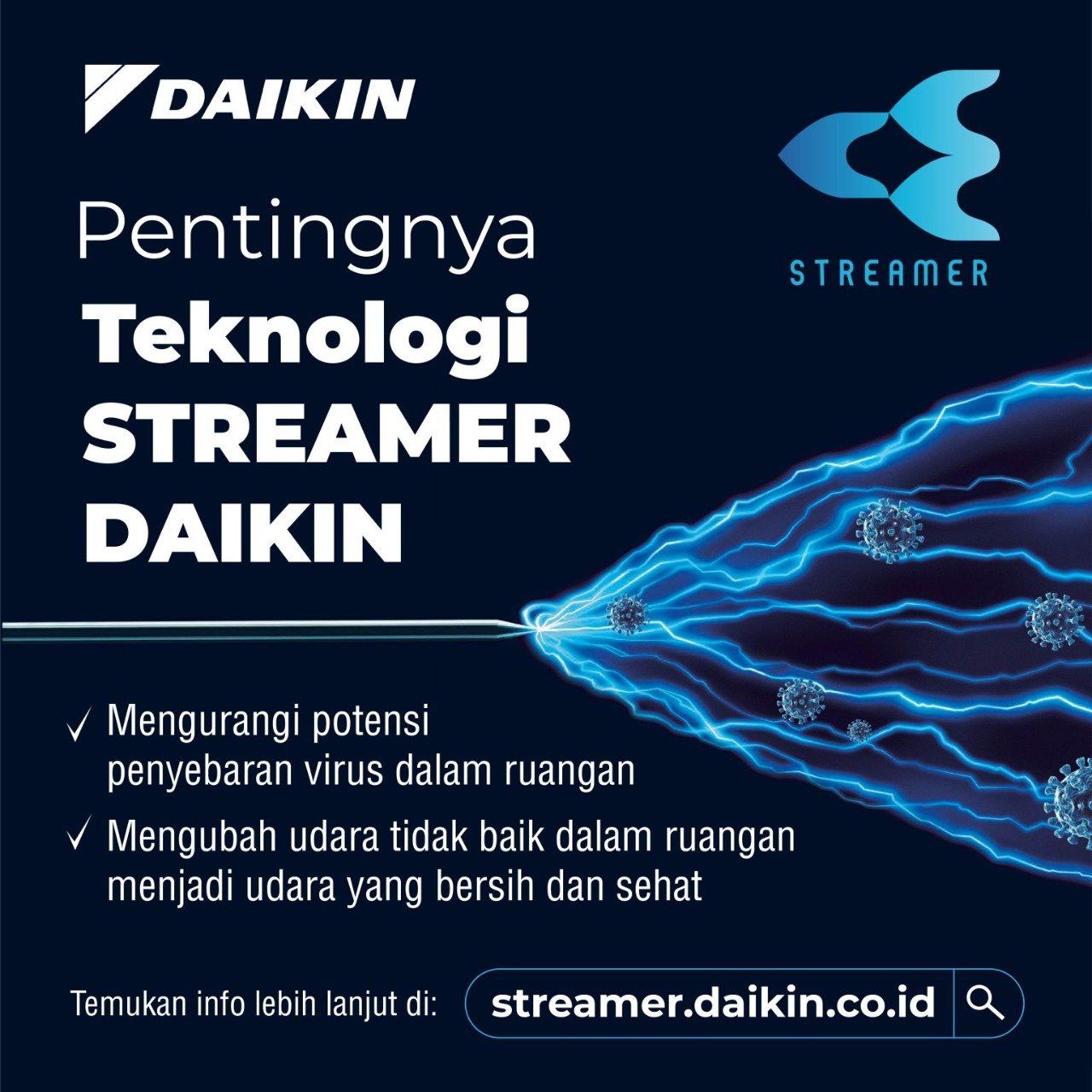
Streamer Technology utilizes Streamer discharge, developed by Daikin in 2004, to perform oxidative decomposition of hazardous substances. This type of plasma discharge represents an innovative air purification technology that stably generates 'high-speed electrons,' an achievement that had proven difficult until its development.
Its oxidative decomposition capability is significantly greater than that of conventional plasma discharges (glow discharge). Furthermore, when combined with air components, these high-speed electrons exhibit powerful oxidative decomposition properties. This capability enables Streamer discharge to continuously eliminate odors, bacteria, and indoor air pollutants such as formaldehyde. To date, Daikin has collaborated with various universities and public research institutions to demonstrate the technology’s effectiveness against highly virulent influenza viruses (Type A H5N1), less virulent influenza viruses (Type A H1N1), murine norovirus, conventional and mutant strains of novel coronavirus (SARS-CoV-2), as well as foodborne toxins and bacteria.
To learn more about the mechanism of Streamer Technology and further demonstration results, please visit our dedicated webpage, the 'DAIKIN Streamer Research Institute', at: https://www.daikin-streamer.com/en/
Virus Types Demonstrated to Date
In addition to the viruses listed above, public institutions have also verified the technology’s effectiveness against 7 types of bacteria (such as Legionella and Pseudomonas aeruginosa), 30 types of allergens (including cedar tree pollen and Dermatophagoides farinae [feces/carcasses]), and 19 types of hazardous chemicals.


