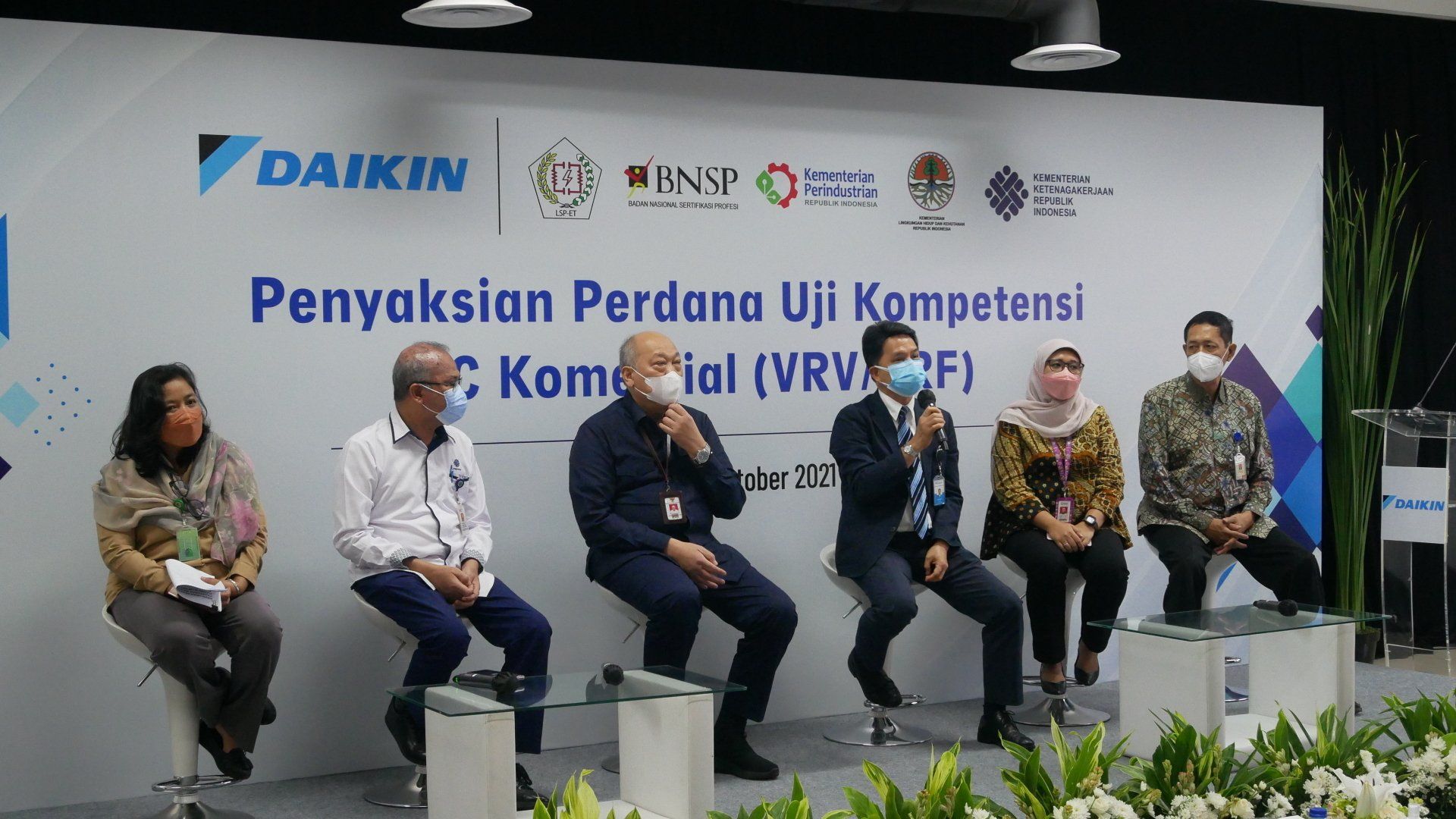
Jakarta - The Indonesian government prioritizes workforce quality, measured by technical ability, theoretical knowledge, and professional conduct, especially amid today’s competitive landscape. Consequently, professionals in the refrigeration engineering sector must obtain state-recognized competency certification through the National Professional Certification Agency (BNSP).
The critical role of the refrigeration engineering workforce is outlined in Minister of Environment and Forestry Regulation No. P.73/MENLHK/SETJEN/KUM.1/10/2019, Article 4. It mandates that technicians at Levels 2 to 5 must hold a valid competency certificate. Furthermore, business operators engaged in related activities are legally required to employ certified technicians.
Compliance in worker certification is crucial. Notably, Article 12 specifies that administrative sanctions will be imposed on business owners or activity managers who fail to comply with this regulation, effective two years after its promulgation on October 18, 2019.
Historically, certification was limited to Levels 1–3 for residential AC units. However, based on the Indonesian Qualifications Framework (KKNI) Regulation No. 41 of 2019, the Ministry of Environment and Forestry introduced new certification schemes covering commercial VRV/VRF and Chiller systems.
In response, PT Daikin Airconditioning Indonesia has consistently enhanced its internal capabilities and Human Resources (HR) quality. On October 18, 2021, Daikin Indonesia partnered with LSP Electrotechnics to conduct the inaugural BNSP-recognized competency test for refrigeration technicians. Daikin strongly endorses this regulatory framework.
Budi Mulia, Director of PT Daikin Airconditioning Indonesia, highlighted that Daikin Indonesia pioneered support for the government’s Level 4 and 5 technician competency initiatives, specifically for VRV/VRF commercial AC systems. “By hosting the inaugural competency test in October at the Daikin National Training Center (NTC) in Jakarta, we facilitated the certification process. Our facility boasts comprehensive practical training modules, precision measuring instruments, specialized tools, adequate workspace, and branch-level training centers equipped with complete facilities. Crucially, technicians are trained on proper refrigerant management to prevent atmospheric release,” explained Budi Mulia.
He added that this initiative will drive higher demand for highly competent refrigeration engineering professionals. Workforce quality will be rigorously evaluated against standardized benchmarks for technical ability, theoretical knowledge, and professional conduct during certification.
Budi Mulia anticipates that Daikin Indonesia’s distribution network (dealers) will increasingly meet certification requirements to better serve consumer needs. Additionally, Daikin continues to support the Ministry of Education and Culture through Memorandums of Understanding (MOUs) signed with 35 Vocational High Schools (SMKs) nationwide.
“We have identified over 300 dealers requiring Level 4–5 certification. Meanwhile, certification for Levels 1–3 remains mandatory and actively enforced for all our dealers,” stated Budi Mulia.
The Daikin National Training Center (NTC) is purpose-built to educate professionals on advanced Air Conditioning Systems. Accredited as a TUK (Competency Testing Center), it houses comprehensive equipment ranging from residential to commercial AC units, fully compliant with government testing regulations.
Furthermore, Daikin Indonesia operates 13 regional branches equipped to administer certifications and provide localized technical support for technicians.
Since its inauguration in July 2018, the Daikin National Training Center has operated on the principle that knowledge sharing is essential to addressing industry challenges, particularly those related to air conditioning systems.
Despite the pandemic, Daikin remained committed to its vision and mission, continuously integrating cutting-edge technologies and fostering active problem-solving in the HVAC sector through structured training and capacity-building programs.
Designed to elevate technical proficiency and industry standards, the NTC caters not only to AC technicians but also to vocational educators, instructors, and students from Job Training Centers, particularly those specializing in Refrigeration and Air Conditioning Engineering (TPTU).
To mitigate COVID-19 risks, offline training sessions strictly adhere to health protocols. Training rooms and equipment undergo regular inspection and sanitization.
Prior to each session, participants (with capped attendance) must undergo temperature screening, wear masks, utilize hand sanitizer, and maintain physical distancing and hygiene throughout the training.
“Our goal is to ensure continuous access to information and training while safeguarding the health of both participants and instructors. Let us enhance AC expertise through the Daikin National Training Center (NTC) and collectively help break the chain of COVID-19 transmission,” concluded Budi Mulia.
Daikin Airconditioning is a leading enterprise in Indonesia. Its air conditioning products are highly sought after due to their sophisticated, energy-efficient, and environmentally friendly technologies.
Established in 1970, the Japanese company has built a strong reputation in the air conditioning market, eventually becoming a market leader in Asia and globally.
Currently, PT Daikin Airconditioning Indonesia manages a distribution network comprising 13 branches across Jakarta, Tangerang, Bekasi, Bandung, Semarang, Yogyakarta, Surabaya, Denpasar, Makassar, Palembang, Pekanbaru, Medan, and Manado, alongside over 1,300 authorized dealers. Daikin also maintains strategic collaborations with the Ministry of Education and Culture, formalized through MOUs with 35 vocational schools nationwide.
Through these partnerships, Daikin conducts specialized training at SMKs. The company’s portfolio spans multiple categories: Residential Air Conditioning, Premium Residential Air Conditioning, Commercial Air Conditioning, and Industrial Air Conditioning.


