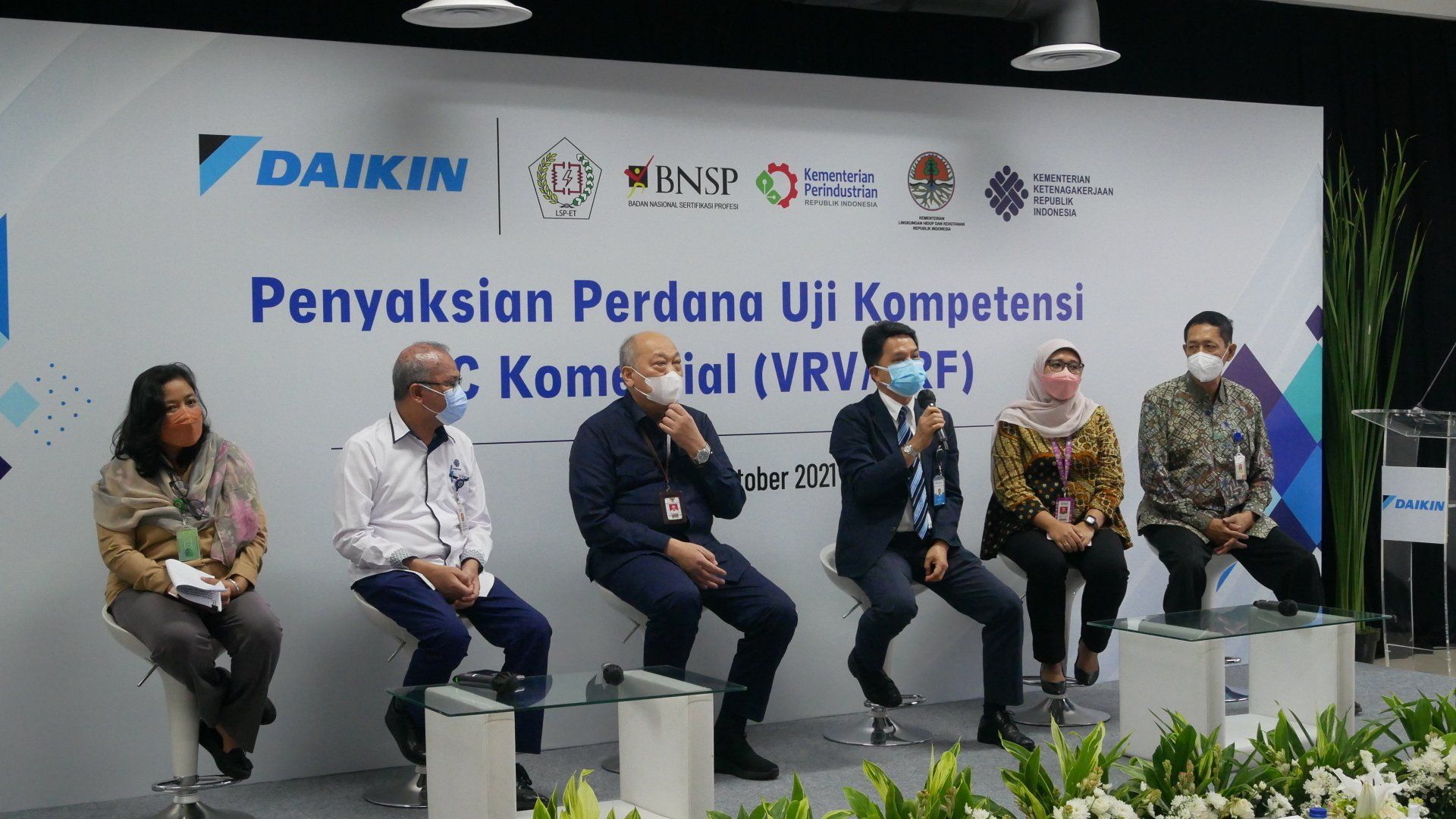
Jakarta - The government is driving workforce quality improvement in Indonesia, measured against standardized competencies, knowledge, and professional conduct amid today's fierce competition. Based on this, personnel in the cooling engineering sector must hold nationally recognized competency certificates issued through the National Occupational Skills Certification Agency (BNSP).
The importance of skilled workers in the cooling engineering sector is outlined in Article 4 of Minister of Environment and Forestry Regulation No. P.73/MENLHK/SETJEN/KUM.1/10/2019, which states that technicians at levels 2 through 5 are required to possess competency certificates. Furthermore, business or activity managers are mandated to employ only certified technicians.
Compliance with these certification requirements warrants close attention. Notably, Article 12 specifies administrative sanctions for business or activity managers who fail to meet their obligations under this regulation, effective two years from the regulation's promulgation on October 18, 2019.
Previously, certification was limited to levels 1–3 for residential AC units. However, the Ministry of Environment and Forestry introduced a new framework based on the Indonesian Qualifications Framework (KKNI) No. 41 of 2019, which includes competency certification for commercial VRV/VRF and Chiller technicians.
PT Daikin Airconditioning Indonesia has responded to this regulation by continuously enhancing its internal operations and upgrading its human resource capabilities. This commitment was demonstrated on October 18, 2021, when Daikin Indonesia, in collaboration with LSP Elektroteknika, hosted the inaugural competency assessment for state-recognized BNSP-certified cooling technicians. Daikin strongly endorses this regulatory initiative.
Budi Mulia, Director of PT Daikin Airconditioning Indonesia, stated that Daikin Indonesia is among the pioneers supporting the government’s initiative to certify technicians at levels 4 and 5, specifically for commercial VRV/VRF systems. “By hosting the first competency assessment in October at the Daikin National Training Center (NTC) in Jakarta, Daikin is facilitating the certification process due to our fully equipped practical units, measurement instruments, tools, dedicated workspace, and comprehensive branch training centers. Most importantly, technicians will be trained on proper refrigerant handling procedures to prevent atmospheric release,” explained Budi Mulia.
Budi Mulia added that this initiative will drive higher demand for highly competent professionals in the cooling engineering field. Workforce quality will be consistently evaluated against the standardized competencies, knowledge, and professional conduct assessed during the certification process.
He is confident that Daikin Indonesia’s distribution network (dealers) will increasingly meet certification requirements to better serve consumer needs. Additionally, Daikin continues to support the Ministry of Education and Culture through Memorandums of Understanding (MOUs) signed with 35 Vocational High Schools (SMK) across Indonesia.
“We have identified over 300 dealers required to obtain levels 4 and 5 certifications. Meanwhile, levels 1 to 3 remain mandatory and actively enforced for all our existing dealers,” said Budi Mulia.
Daikin operates a dedicated training facility known as the Daikin National Training Center (NTC), designed to meet public demand for advanced Air Conditioning System education. Officially designated as a Competency Testing Center (TUK), the NTC is equipped with comprehensive resources ranging from residential to commercial AC systems, fully prepared to administer government-compliant competency assessments.
Furthermore, Daikin Indonesia maintains 13 regional branches ready to facilitate this certification program and provide localized support for technicians across the country.
Since its establishment in July 2018, Daikin has firmly believed that knowledge should be shared to effectively address current challenges, particularly those related to air conditioning systems.
Despite the pandemic, Daikin remains steadfast in executing its vision and mission, introducing cutting-edge technologies, and proactively innovating solutions for AC-related challenges. This is consistently achieved through continuous training and skill enhancement programs for participants.
The national training center is engineered to elevate technical competencies and raise overall industry standards. While AC technicians are a primary audience, the curriculum also prioritizes instructors and students from Vocational High Schools specializing in Cooling and Air Conditioning Engineering (TPTU), as well as trainees from Regional Training Centers focusing on TPTU disciplines.
To implement preventive measures against COVID-19 and promote safety, all offline training sessions strictly adhere to health protocols. Training rooms and equipment undergo routine inspections and sanitization.
Prior to each session, attendance is capped, and all participants are required to undergo temperature checks, wear masks, use hand sanitizer effectively, and maintain physical distancing and hygiene throughout the training.
“Our goal is to ensure that information dissemination and training continue seamlessly while safeguarding the health of both participants and trainers. Let us advance our AC expertise together with the Daikin National Training Center (NTC) and help break the chain of COVID-19 transmission,” concluded Budi Mulia.
Daikin Airconditioning stands as one of Indonesia’s leading companies. Indeed, Daikin-manufactured Air Conditioners (ACs) have proven highly popular among domestic consumers due to their advanced, eco-friendly technologies.
Established in Japan since 1970, with a strong focus on AC products, it is no surprise that Daikin has become the market leader among AC manufacturers in Asia and globally.
For reference, PT Daikin Airconditioning Indonesia currently operates a distribution network comprising 13 branches in Jakarta, Tangerang, Bekasi, Bandung, Semarang, Yogyakarta, Surabaya, Denpasar, Makassar, Palembang, Pekanbaru, Medan, and Manado, alongside more than 1,300 authorized dealers. Daikin has also partnered with the Ministry of Education and Culture, formalized through MOUs with 35 vocational high schools nationwide.
In this capacity, Daikin conducts specialized training programs at these institutions. Daikin’s product portfolio is strategically categorized into Residential AC, Premium Residential AC, Commercial AC, and Industrial AC solutions.


