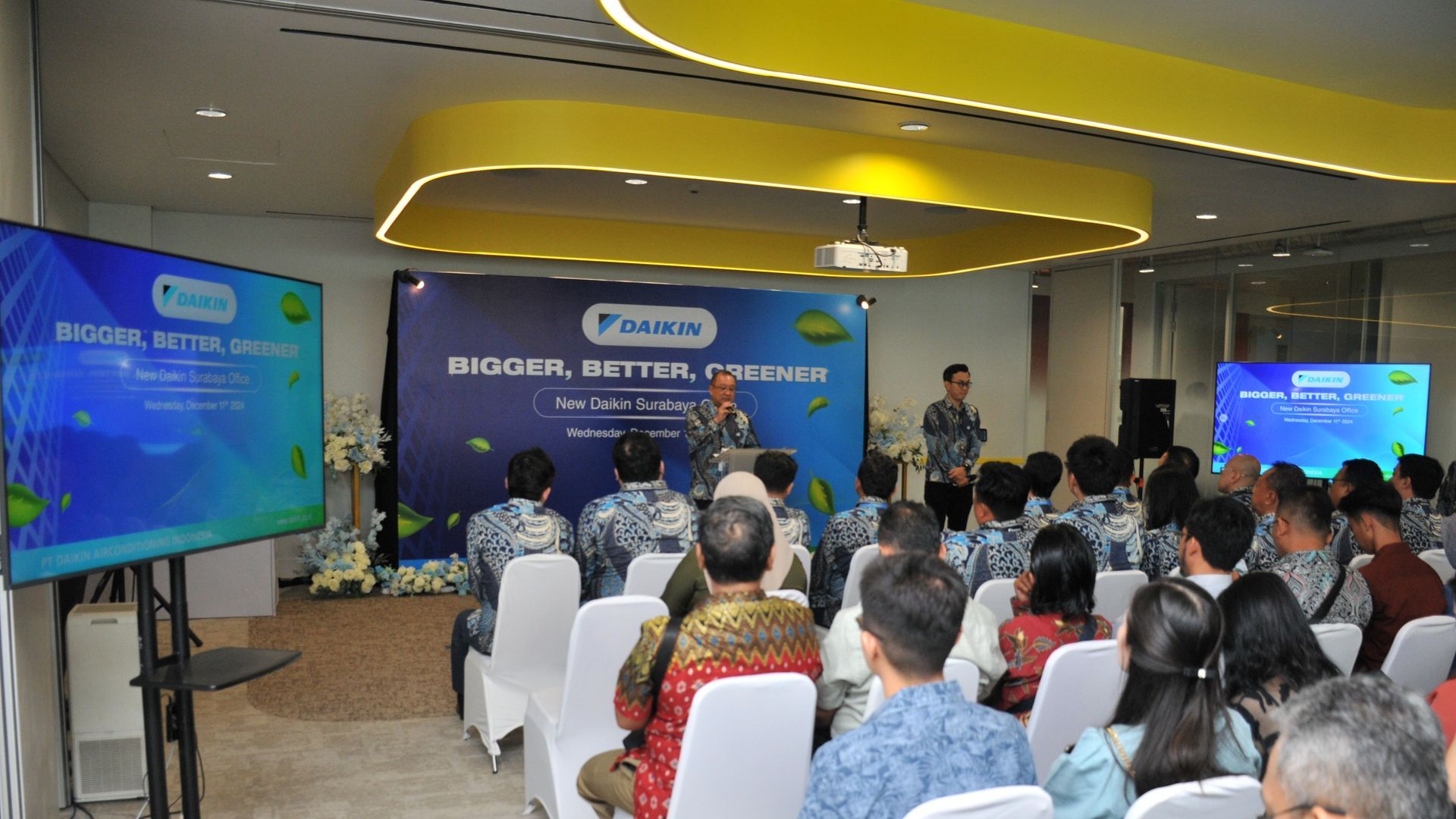
Surabaya – As the year draws to a close, PT Daikin Airconditioning Indonesia (DAIKIN) appears to be accelerating its business operations across Indonesia. This momentum was recently highlighted by the inauguration of DAIKIN’s new branch office serving Surabaya and its surrounding regions. Far more than just an expansion of its previous facility, this new branch is designed to deliver comprehensive services, offering visitors a unique experience while prioritizing environmental sustainability.
“The establishment of this new DAIKIN branch office in Surabaya reflects our commitment as public trust continues to grow. By moving into a larger facility, we aim to provide more comprehensive services and an enhanced visitor experience, all aligned with our ongoing efforts to operate more sustainably,” said Shinji Miyata, President Director of PT Daikin Airconditioning Indonesia.
This statement becomes immediately clear upon visiting the Japanese air conditioning solutions provider’s branch office in Surabaya. Located in a standalone building at Jalan Kombes Pol Moh. Duryat No. 29–31, Tegalsari District, Surabaya, East Java, the facility spans four floors plus a basement level designated for motorcycle parking.
Stepping inside, the space feels anything but a traditional office. Visitors are greeted by a spacious, open layout featuring strategically arranged display units designed to help them easily explore information about DAIKIN’s air conditioning solutions.
Beyond residential AC units, visitors can also view and receive direct information on commercial air conditioning systems. The AC equipment is integrated directly into various areas of the space, complete with diverse control interfaces. In several sections, DAIKIN even showcases actual installation setups. Meanwhile, DAIKIN consultants are stationed throughout to assist every visitor.
“We intentionally designed the space to make visits engaging and interactive. It provides a distinct experience while making it easier for visitors to visualize DAIKIN’s full range of AC products and access professional consultant support to find the perfect air conditioning solution tailored to their needs,” added Shinji Miyata.
On another note, Shinji Miyata explained that the branch office also functions as a dedicated after-sales service hub. To support this, the expanded warehouse dimensions ensure better availability of technicians, spare parts, and other essential maintenance materials.
Further solidifying its role as DAIKIN’s regional hub in Surabaya, the facility includes a fully equipped training room along with supporting educational tools. These resources cater not only to internal staff but also to upskill human resources, particularly technicians from DAIKIN’s business partners. “This comprehensive training facility ensures that both our internal teams and partner technicians maintain high competency levels, enabling us to deliver the best possible service to DAIKIN product users,” stated Shinji Miyata.
Shinji Miyata further emphasized that establishing this operational hub for Surabaya and its surrounding areas goes beyond merely offering complete services. More importantly, it reflects DAIKIN’s strong commitment to fostering environmental sustainability.
As a tangible demonstration of this commitment, Shinji Miyata noted that the branch office was designed incorporating multiple green building principles. Currently, DAIKIN is preparing to install solar panels on the building to support government initiatives aimed at reducing carbon emissions. Furthermore, in line with all its broader environmental initiatives, the facility is currently undergoing the process to obtain official Green Building Certification.
“We invite the public to visit our new DAIKIN branch office in Surabaya. Guests can enjoy a unique, hands-on experience with DAIKIN’s comprehensive air conditioning solutions, guided by consultants ready to provide expert advice and recommendations. Visitors will also get to personally experience the comfort of a building designed with a deep commitment to sustainable environmental practices,” concluded Shinji Miyata.


