Incorrect Placement Drives Up Costs: The Ideal AC Position for Bedrooms
Variations in AC air distribution can create temperature differences of up to 3°C within a single room, leaving one side feeling cold while the other remains stuffy. So, what is the correct AC position in a bedroom to ensure an even and comfortable temperature?
Many people focus on lowering the temperature setting on the remote, but proper AC placement in a bedroom actually dictates airflow direction, temperature stability, and electrical efficiency. If your AC has felt “inconsistent,” it might not be about the settings—it could be about its location.
Consistent Cooling Starts with Proper Airflow Pathways
An AC system doesn’t cool a single point; rather, it circulates air to evenly lower the room temperature. Cool air exits the unit, gradually sinks, and pushes warm air back up toward the unit to be cooled again.
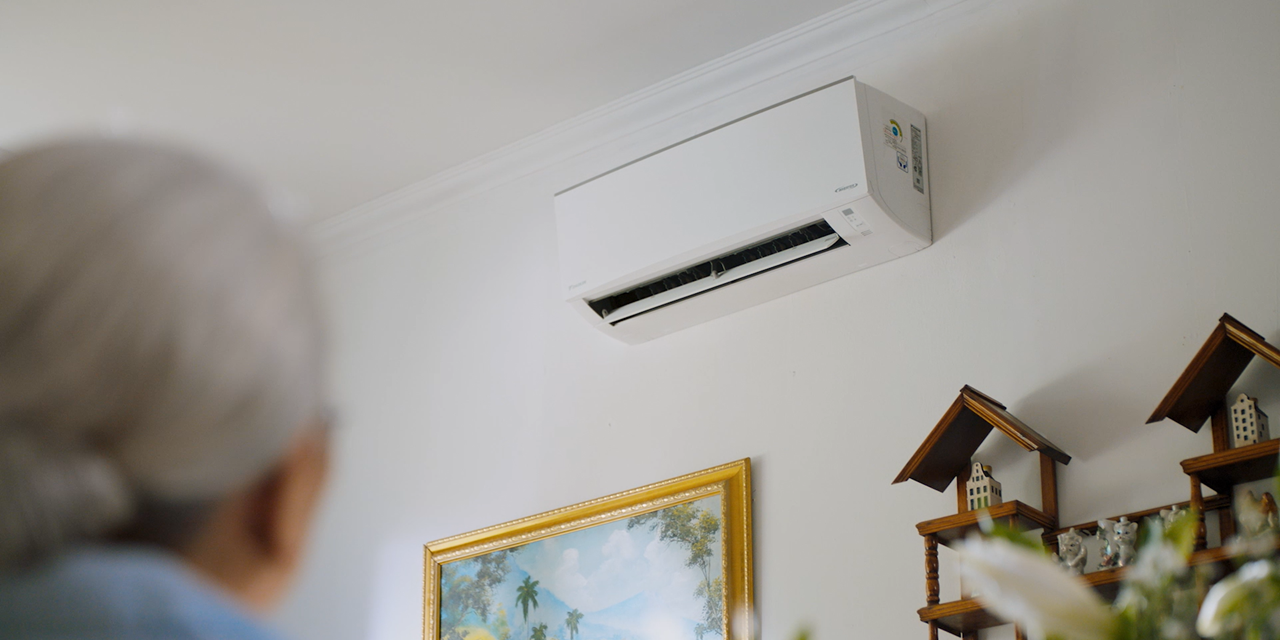
Therefore, higher mounting is crucial, with the AC positioned approximately 10–15 cm from the ceiling to keep intake and discharge spaces optimal. If mounted too low or obstructed, airflow is disrupted, creating cold spots on one side and hot corners on the other.
Thus, positioning isn’t just about aesthetics; it’s about how stable the circulation works—which significantly impacts comfort around the sleeping area.
The Correct AC Position in Bedrooms: Avoid Directing Airflow at the Body
Pointing the AC toward the bed—especially directly above the head or feet—may feel “quickly cool,” but it often disrupts sleep. Direct airflow hitting the skin triggers localized cooling and unpredictable air movement.
As a result, the body slips into lighter sleep stages without realizing it. This is known as micro-arousal: you don’t fully wake up, but rest quality drops, leading to dry throat and muscle stiffness upon waking.
A more comfortable solution is placing the unit parallel to the bed, directing airflow toward the opposite wall, or bouncing it off the ceiling so cool air descends gradually. Interestingly, our bodies are more sensitive to direct drafts than minor temperature changes.
Maintain Clearance from Ceilings and Furniture
The AC requires overhead space as an air intake pathway, so adequate clearance ensures smooth circulation. When placed too close to the ceiling, tall wardrobes, or covered by curtains, airflow is blocked, and the AC’s discharge direction during sleep no longer spreads evenly.
The result isn’t just a room with uneven cold-hot patches; cooling efficiency can drop by 10–20%, or even more under heavy loads. Placement near doors or windows also increases thermal load as outside air constantly enters, forcing the AC to work harder and raising electricity consumption.
Ideally, leave clear space around the unit and avoid direct obstructions in the discharge path. With proper spacing, cool air moves steadily, temperatures remain consistent, and energy usage stays controlled.
Height and Slope Determine Drainage Flow
To maintain even airflow while ensuring the drainage system operates optimally, consider the following points:
- Mount the split AC at a sufficient height from the floor to help cool air descend gradually and distribute evenly throughout the room.
- Tilt the indoor unit slightly toward the drain pipe so condensate water doesn’t pool in the drip pan.
- The ideal drain line slope is 2–2.5 cm per meter to ensure water flows freely without standing water.
- Mounting too low results in suboptimal air distribution and increases moisture-related risks.
- Imprecise sloping can lead to leaks, odors, and mold growth, which accelerate performance degradation.
Proper initial installation keeps drainage flowing smoothly, maintains stable airflow, and extends the unit’s lifespan.
Outdoor Unit Placement Supports Indoor Performance
To maintain stable and efficient cooling, observe the following guidelines:
- Ensure the outdoor unit has open ventilation so heat dissipates easily, reducing compressor workload.
- Avoid narrow or enclosed spaces, as they hinder heat rejection and reduce efficiency.
- Keep piping runs reasonably short to help maintain optimal refrigerant pressure.
- Minimize direct sunlight exposure. Lower condenser temperatures result in more stable cooling.
- Use a solid, vibration-free mounting surface to minimize mechanical stress on the compressor.
- Ensure outdoor airflow isn’t blocked by walls or objects to guarantee continuous circulation.
When the outdoor unit has room to “breathe,” the system operates more efficiently. The core principle remains the same: never point the AC directly at the bed.
Common Mistakes That Make AC Feel “Inconsistent”
AC installations in minimalist bedrooms often follow furniture layouts rather than airflow patterns. Units placed directly above the head, tucked behind tall cabinets, mounted too close to the ceiling, or chosen solely for wall symmetry may look tidy.
However, such placements disrupt system operation. Consequently, air doesn’t circulate properly, temperatures fluctuate, and the compressor cycles on and off frequently to reach the set point.
The most noticeable effect is one side of the room cooling quickly while the other lags behind. Meanwhile, electricity consumption rises significantly as the unit works harder than necessary.
Conversely, when airflow is properly designed from the start, temperatures stabilize, compressor operation becomes smoother, and sleep feels deeper. This means optimizing not just the unit’s location, but the entire cooling system within the space.
Proper Cooling Begins with Proper Placement
Ultimately, sleep comfort isn’t about achieving the lowest temperature setting, but how evenly, stably, and efficiently air moves throughout the room. Every space has different dimensions, capacity requirements, and layouts, demanding a precise approach rather than a standard installation.
DAIKIN AC units are engineered with smooth airflow, stable operation, and flexibility for various layouts. This allows you to find the correct AC position in your bedroom without compromising comfort. Contact us to discover an AC that not only feels cool but delivers genuine comfort and energy savings.


